
Within 24 hours for anything at three stars or below, within a week for the rest, and never within ten minutes of a bad one. Google advises responding in a timely manner, because a prompt response shows you value feedback. The practical target that works for most businesses is a daily check of five minutes, which is enough to catch everything that matters without turning review replies into somebody’s full time job.
How fast you should reply to reviews comes down to one thing: the next customer is reading the complaint now, and an unanswered complaint reads as an admission.
Targets that hold up
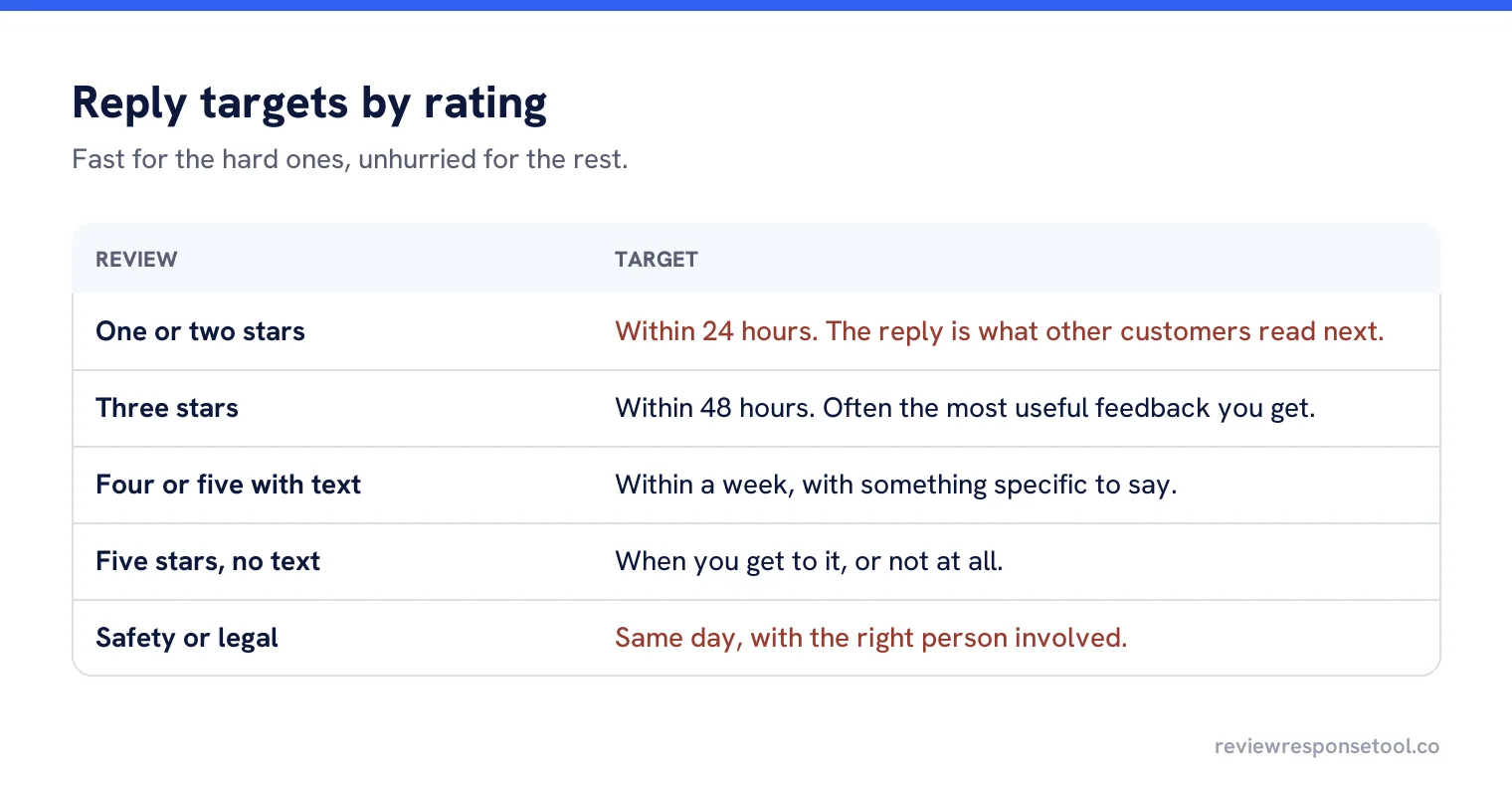
| Review | Target | Why |
|---|---|---|
| One or two stars | Within 24 hours | The reply is the first thing other customers read after the complaint. |
| Three stars | Within 48 hours | Often fixable, and often the most useful feedback you get. |
| Four or five stars with text | Within a week | Worth a specific reply, not an urgent one. |
| Five stars with no text | When you get to it, or not at all | Nothing to respond to. Google suggests focusing replies where you can add something. |
| Anything mentioning safety or a legal matter | Same day, with the right person involved | These are not marketing problems. |
Why not immediately
Two reasons. The first is practical: the first version of a reply to a bad review is almost always the wrong one, and a short delay is what produces the calm version. The second is operational: replying within minutes, at midnight, on a weekend, sets an expectation you cannot keep at scale.
A reply the next working morning is fast enough for every reader and sustainable for every business.
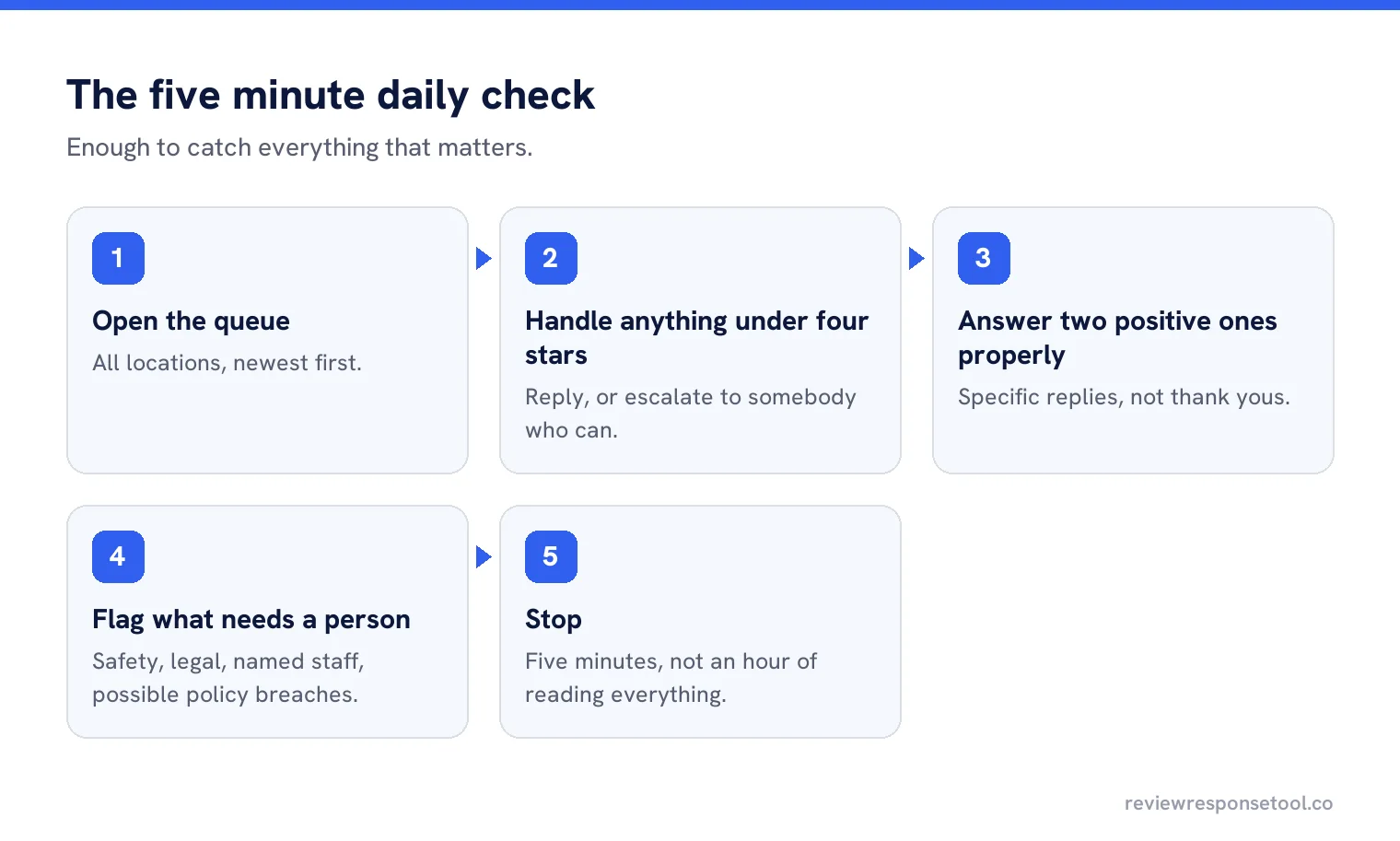
The five minute daily check
Open the queue
All locations, newest first.
Deal with anything under four stars
Reply, or escalate to whoever can.
Pick two positive ones to answer properly
Specific replies, not thank yous.
Flag anything that needs a person
Safety, legal, a named member of staff, a possible policy breach.
Stop
Five minutes. Not an hour of reading everything.
Alerts, not refreshing
Nobody should be checking the profile manually several times a day. An alert on new reviews, routed to the person who replies, turns this from a monitoring job into a short task that arrives when there is something to do. Without one, businesses either check obsessively for a week and then stop, or find out about a bad review when a customer mentions it.
Out of hours
Decide in advance and write it down. For most businesses, reviews arriving at the weekend are answered on Monday, and that is acceptable. For hospitality and emergency services it is not, because a Saturday night complaint is read by Sunday lunchtime customers. If that applies, someone needs weekend access and a clear limit on what they may say without approval.
Catching up on a backlog
Plenty of businesses arrive at this with two years of unanswered reviews. Do not reply to all of them. Answering eighty reviews in one afternoon produces eighty replies with the same timestamp, which looks exactly like what it is and makes the neglect more visible rather than less.
The sensible approach is to answer every negative review, oldest to newest, over a week or two, and a sample of the positive ones with something specific to say. Then start replying to everything new from today. Within a month the recent reviews all have replies, which is what anyone reading the profile actually sees.
Who needs to be able to reply
More people than currently can. The single biggest cause of slow replies is that one person holds access and they are on holiday, in surgery, or on site. Give every location a named person and a named deputy, both with access, and agree what they may say without checking: in most businesses that is everything except clinical, legal and safety matters.
Reply speed across locations
In a group, speed is the measure that exposes which branches have a process. Report median time to reply per location rather than an average, because one ignored review for three months distorts a mean beyond usefulness.
Where a branch is consistently slow, the cause is nearly always that nobody there has access, or that replies have to be approved by somebody who is busy. Both are fixable in an afternoon, and neither is a motivation problem.
What slow replies cost
Nothing measurable in ranking terms that anyone can demonstrate. What they cost is conversion: a reader deciding between two businesses sees one that answers its critics and one that does not. That comparison happens in seconds and it is not recorded anywhere you can audit.
A worked routine
A dental group with eleven practices. Reviews arrive in one queue. Practice managers handle their own, with a 24 hour target for anything under four stars and a weekly sweep for the rest. Anything clinical goes to the lead dentist before posting, which is a named exception rather than a general approval step.
Median reply time went from nine days to under one, and the only new tool was an alert. The change that mattered was giving eleven people access rather than routing everything through head office.
When a reply should wait
Where there is a dispute, an insurance claim or anything legal, the right answer is to post a short holding reply and take the detail offline. “Thank you for raising this. We take it seriously and would like to discuss it with you directly; please contact [name] on [number].” That is fast, it says nothing that can be used, and it does not leave the complaint unanswered.
Speed is not the same as quality
A fast reply that says nothing is worse than a considered one a day later. Where the two conflict, choose the better reply: the reader cannot see your target, only what you wrote. The targets exist to stop reviews being ignored, not to turn replying into a race.
Measuring it
Two numbers, monthly: median time to reply, and percentage of reviews with a reply, split out for one and two star reviews. The second number is the one that moves first when a process is slipping, usually because the difficult ones are being left while the easy ones are answered.
Everything in one queue
See every review from every location as it arrives, with alerts on the ones that cannot wait.
Frequently asked questions
How quickly should I reply to reviews?
Within 24 hours for one and two star reviews, 48 hours for three stars, and within a week for positive ones with text. Google advises responding in a timely manner.
Should I reply immediately to a bad review?
No. The first version of a reply written in the moment is almost always the wrong one, and replying within minutes at any hour sets an expectation you cannot keep.
Do I need to reply to every five star review?
No. Google suggests focusing replies where you can add something useful rather than sending the same thank you to everyone.
What about reviews that arrive at the weekend?
For most businesses Monday is fine. For hospitality and emergency services it is not, because a Saturday complaint is read by Sunday customers.
What should I measure?
Median time to reply and the share of reviews with a reply, reported separately for one and two star reviews, which is where slippage shows first.
Sources
The Google documentation behind the guidance on this page. Google changes these pages without notice, so check the date on any figure before you rely on it.