
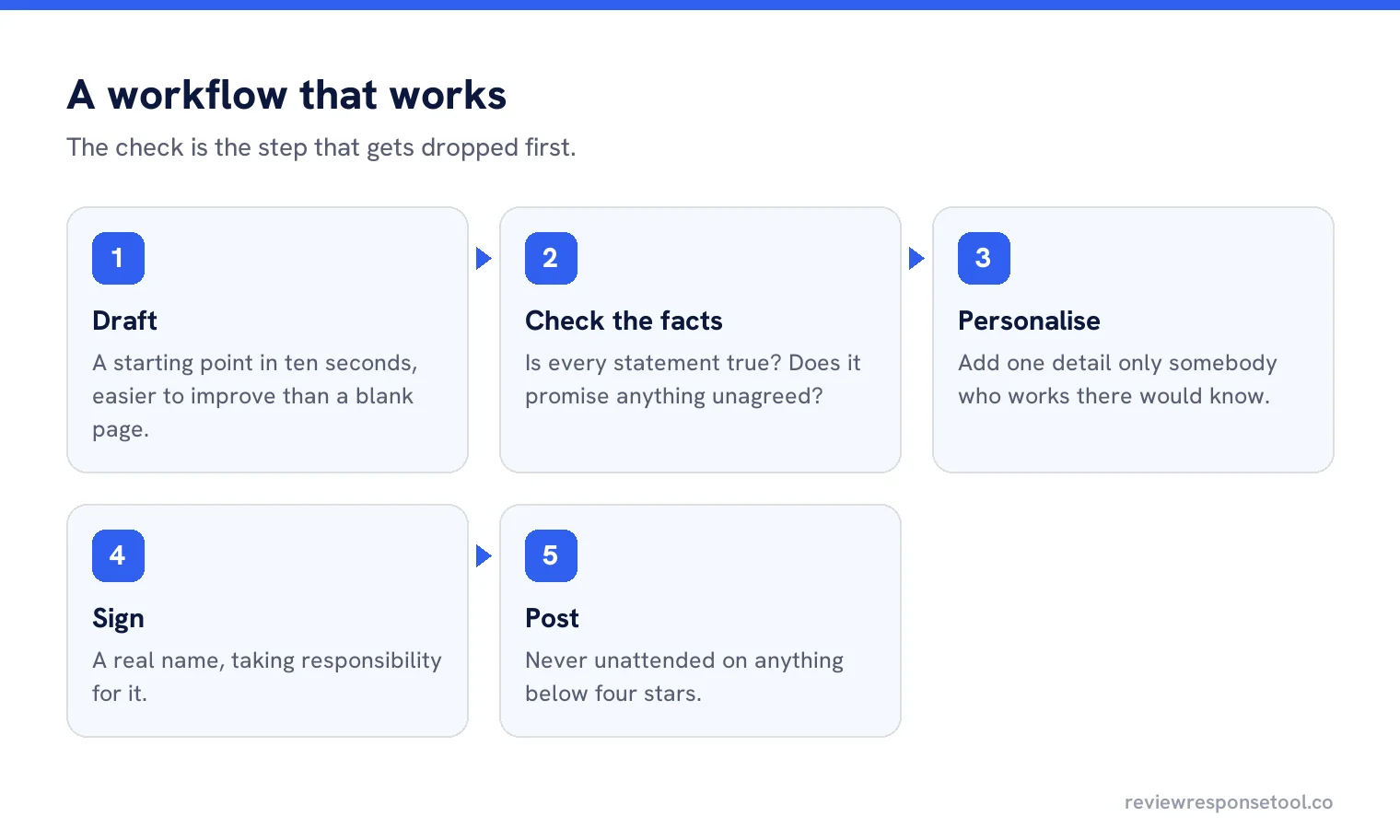
Use it to draft, never to publish. A generated reply is a starting point that still needs the one thing it cannot know: what actually happened. The workflow that works is draft, edit for facts, add a detail only you know, sign with a real name, post. Never let it answer a complaint unattended, never let it confirm details about a customer, and check anything it writes about a regulated service before it goes anywhere near the profile.
Using AI to draft review replies appeals to anybody facing forty unanswered ones. The failure mode is equally obvious to anybody reading a profile where every reply begins “Thank you so much for taking the time”.
Where it genuinely helps
Getting past the blank page
A draft in ten seconds is easier to improve than nothing is to start.
Volume of positive reviews
Where there is little to say, a varied draft beats the same thank you thirty times.
Tone under pressure
It will not write the angry version you would have written at nine at night.
Translation
A reasonable reply in a language nobody on the team speaks.
What customers notice
Readers rarely guess that an individual reply was drafted by software. What they notice is a page of them: the same cadence, the same opening, the same closing offer to make things right. That pattern reads as a business that processes reviews rather than one that reads them, which is precisely the impression the replies were meant to prevent.
Where it fails
| Problem | What it looks like |
|---|---|
| It invents facts | Apologising for something that did not happen, or promising a refund nobody authorised. |
| It agrees too readily | Accepting blame for things outside your control, which Google specifically advises against. |
| It sounds the same | Thirty replies with the same rhythm and the same opening. |
| It leaks detail | Repeating what the customer bought or when, which is a privacy problem. |
| It is too long | Four paragraphs where two sentences would do. |
| It cannot know the local detail | The one thing that makes a reply worth reading. |
A workflow that works
Draft, check, personalise, sign, post. The check is the important step and it is the one that gets dropped once people trust the tool. Ask three questions of every draft: is every fact in it true, does it promise anything we have not agreed, and does it say anything about this customer that they did not say themselves?
Rules worth writing down
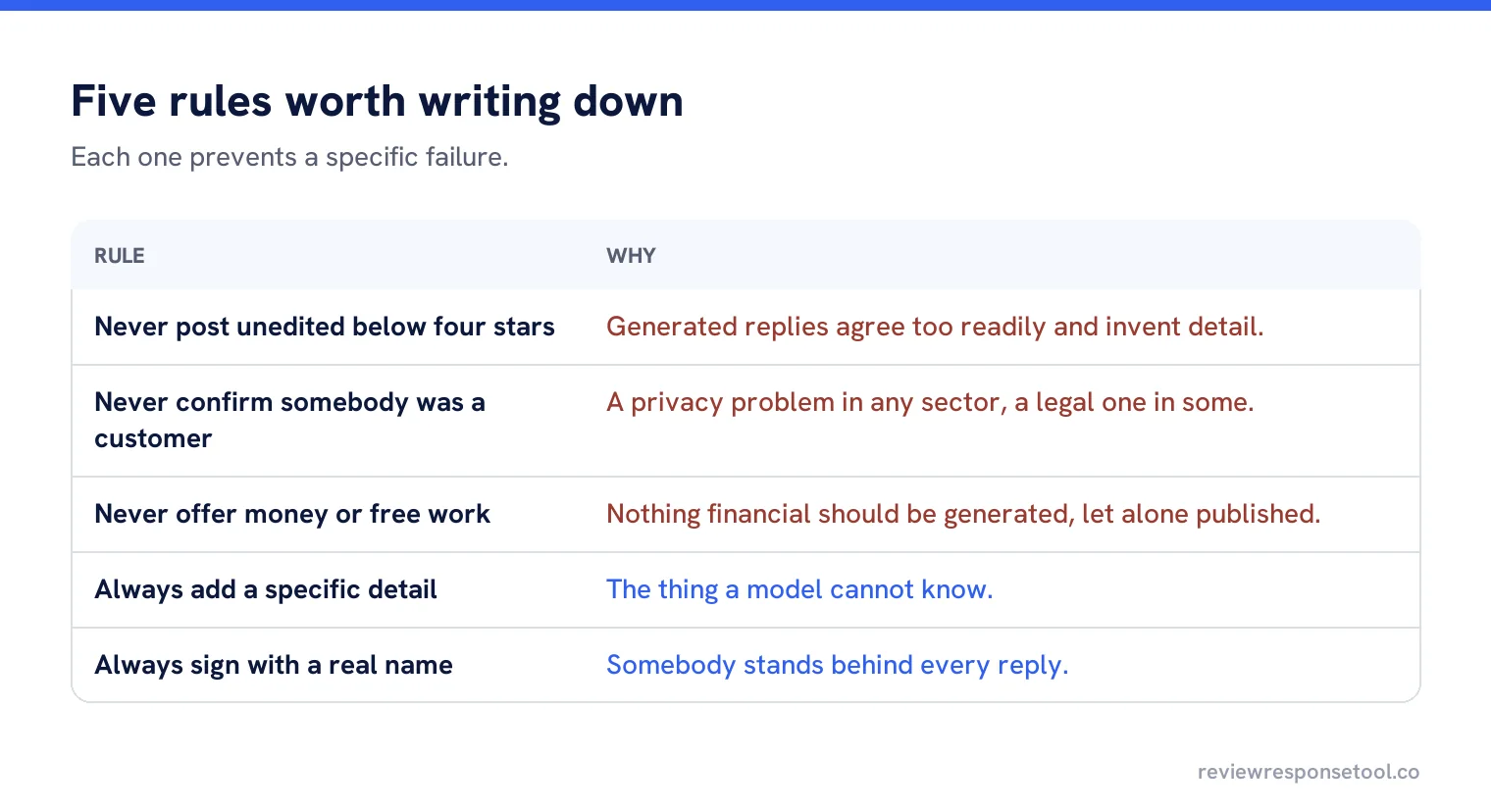
- Never post an unedited draft to a review below four stars.
- Never let it confirm that somebody was a patient, client or customer.
- Never let it offer money, refunds or free work.
- Always add one specific detail a person would know.
- Always sign with a real name.
Giving it something to work with
The quality of a draft depends almost entirely on what the tool knows about the business. Three things make a visible difference: the kind of business it is, a short style note describing how you write, and a list of things you never say. Without those it produces generic corporate English, because that is the safest average of everything it has seen.
Where a tool allows it, adding the facts of the specific case before drafting changes the output completely: “the delay was a parts shortage, we did not call the customer, the part arrived on Tuesday” produces a reply that already contains the truth and needs only tidying.
Multi-location businesses
Generated replies are most tempting and most dangerous at scale, because one bad pattern repeats across every location at once. Two safeguards are worth the effort: a different person signing in each location, so replies are not all from “the team”, and a monthly read of a sample across branches to check they have not converged on the same three sentences.
Regulated and sensitive sectors
Healthcare, legal, financial services and anywhere with a professional body: generated replies are riskier than elsewhere, because the error is not a clumsy sentence but a confidentiality breach or a claim you are not allowed to make. In those settings the draft should be treated as a prompt for a human, and the human should be someone who knows the rules.
Does it matter that the reply is assisted?
Not to the reader, provided the result is accurate, specific and signed by somebody who takes responsibility for it. What matters is whether the reply is true and whether anybody stands behind it. A generated reply that a manager has read, corrected and signed is a reply from that manager.
What is not acceptable is unattended automation on complaints, because the business is then responding to customers without knowing what it said.
A worked example
Review: “Lovely staff but the room was freezing and the heater didn’t work.”
Draft: “Thank you so much for your feedback. We are delighted you enjoyed our staff and we sincerely apologise for the temperature of your room. We strive to provide a comfortable stay and will address this with our maintenance team.”
Edited: “Thanks Carol, and sorry about the cold. The heater in room four was faulty and has been replaced this week. Glad the team looked after you. Ask for room six next time, it is the warmest in the building. Ruth.”
The edit took thirty seconds and added the two things the draft could not contain: what was actually wrong, and a detail only somebody who works there would know.
What to do with the time it saves
The saving is real: a business answering forty reviews a month can get most of an hour back. Spend it on the two things nothing can automate. Read the complaints for patterns, because three people mentioning parking in a fortnight is a finding. And call one or two of the unhappy customers, which produces more than any reply ever will.
Measuring whether it is helping
Two things worth watching. Reply rate and speed, which should both improve. And variety: read your last twenty replies and check they do not all open the same way. If they do, the tool is writing and nobody is editing.
Drafts you finish in seconds
Suggested replies for every review, with your own voice, ready to edit and sign before they go out.
Frequently asked questions
Can I use AI to reply to reviews?
To draft, yes. To publish unattended, no. A generated reply cannot know what actually happened, which is the only thing that makes a reply worth reading.
What goes wrong with generated replies?
Invented facts, accepting blame for things outside your control, identical rhythm across every reply, leaked customer detail, and excessive length.
Should every reply be checked?
Yes, and especially anything below four stars. Ask whether every fact is true, whether it promises anything unagreed, and whether it reveals anything the customer did not.
Is it dishonest to use assistance?
Not if the reply is accurate, specific and signed by somebody who takes responsibility. Unattended automation on complaints is the part that is not acceptable.
What about regulated sectors?
Higher risk, because the error is a confidentiality breach or a prohibited claim rather than a clumsy sentence. Treat the draft as a prompt for somebody who knows the rules.
Sources
The Google documentation behind the guidance on this page. Google changes these pages without notice, so check the date on any figure before you rely on it.